


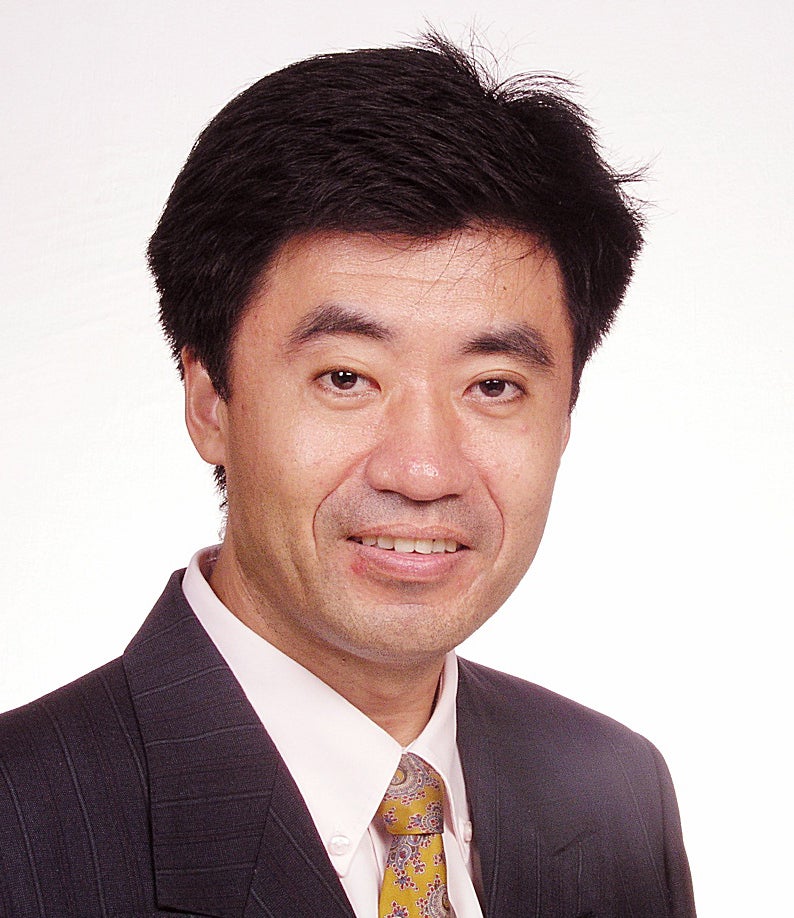
Shuzhi Sam Ge
Professor Shuzhi Sam Ge
Faculty & Department
Joint Appointments
Professor, Integrative Sciences and Engineering
Director, NUS Guangzhou Research Translation & Innovation Institute, NUS Guangzhou Research Translation and Innovation Institute, Office of the President
Director, NUS Guangzhou Research Translation and Innovation Institute, Office of the President
Education
Doctor of Philosophy, Imperial College London, United Kingdom
Bachelor of Technology, Beijing University of Aero. & Astro., China
Bio
Shuzhi Sam Ge is a full Professor at the Department of Electrical and Computer Engineering, and Senior Faculty Member, Integrative Sciences and Engineering, NUS Graduate School, National University of Singapore. He serves as Singapore Lead for INdo-PACific-European Hub for Digital Partnerships (INPACE): Trusted Digital Technologies for Sustainable Well-Being, Horizon Europe Program, and Director of NUS Guangzhou Research Translation & Innovation Institute (NUS GRTII). He received his BSc from the Beijing University of Aeronautics and Astronautics in 1986, and his PhD and DIC from Imperial College London in 1993. He has received numerous awards and honours, including the China Outstanding Young Scholar Award for Overseas Scholars, and the Singapore National Science and Technology Award, among over 20 other distinctions. He has also been recognized annually as a Clarivate Highly Cited Researcher (Top 1%) since 2016 annually to 2024. He serves as President of the Asian Control Association (2024–2026), IFAC Council Member (2023–2026), and IEEE Control Systems Award Committee Member (2024–2026). He had also served as VP of Technical and Membership Activities for the IEEE Control Systems Society 2009-2012. He is the founding Editor-in-Chief of the International Journal of Social Robotics and serves/served as either a Senior Editor or an Associate Editor for a number of flagship journals including IEEE Transaction on SMC-Systems, IEEE Transactions on Automatic Control, IEEE Transactions on Control Systems Technology, IEEE Transactions on Neural Networks, and Automatica, CAAI Transactions on Intelligence Technology, and serves as Book Editor of Automation and Control Engineering Series of the Taylor & Francis/CRC Press. He has authored 9 monographs and over 900 publications. A Fellow of IEEE, IFAC, IET, and the Singapore Academy of Engineering, his research interests include intelligent control, AI, robotics, functional materials, and translational research.
Contact Information
Welcome on board NUS ISEP, the best program on offer globally. Honor to work with you for your PhD research in Robotics, AI and Intelligent Control
We excel in Artificial Intelligence, Robotics, Intelligent Control.
- Development of Stable Robust and Secure Intelligent Systems for Autonomous Vehicles under AI Singapore Grand Challenge in Robust AI, WBS: A-8001525-00-00, S$ 2,554,800.00, 07/2023 – 06/2025, PI.
- Team PI, Modular Reconfigurable Mobile Robots, S$10,969,686 funded by A*Star (Agency for Science, Technology and Research), under the Singapore Industry Alignment Funds – Pre-positioning (IAF-PP) Programme, 1 March 2025 – 29 February 2028 (awarded on 6 January 2025).
- ENFORCE-ENabling Future Systems for Offshore Wind ResourCEs, A*Star , S$ 18,157,087 (inclusive of overheads) for 4 years, 2023 -2027 (S$7,508,345 will be allocated for Phase 1 funding (Covering Year 0 to Year 1.5) and S$10,648,742 for phase 2 funding (covering Year 1.5 to Year 4) will be released upon a satisfactory progress review after 12 months from project start date), Co-Investigator.
- Coupled Engine-Vessel Physics with Data Driven AI Models for Carbon Emissions Estimation, Singapore Maritime Institute (SMI), $1,488,792, 02/2023-01/2025 Co-PI.