

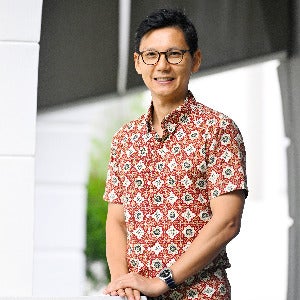
Chin-Hao Huang
Faculty & Department
Education
Doctor of Philosophy, University of Southern California, United States
Bachelor of Science, Georgetown University, Washington D.C., United States
Bio
Chin-Hao Huang is Associate Professor of Political Science and co-Director of the Centre on Asia and Globalisation at the Lee Kuan Yew School of Public Policy, National University of Singapore. Huang’s research and teaching focus on the intersection of international politics and regional security in Asia, with an empirical emphasis on China, Southeast Asia, and U.S.-China relations. His work examines the patterns of cooperation and conflict in historical and contemporary Asia, and how countries with disparate capacities in the region develop the requisite norms, consensus, and institutional mechanisms to achieve security. He is recognized as one of the top 30 global voices and intellectual innovators shaping the future of public debates on international affairs in Project Syndicate’s inaugural Forward Thinkers list.
Huang has published three books on regional security in Asia: Power and Restraint in China’s Rise (Columbia University Press, 2022; Honorable Mention for the T.V. Paul Best Book in Global International Relations) identifies and explains the conditions under which China defers to the consensus of smaller neighboring countries on regional security rather than running roughshod over them; State Formation through Emulation: The East Asian Model (Cambridge University Press, 2022) investigates why neither war nor preparations for war were the cause or effect of state formation in East Asia; and Identity in the Shadow of a Giant: How the Rise of China is Changing Taiwan (Bristol University Press, 2021) examines the implications of the global ascent of China on cross-Strait relations and the identity of Taiwan as a democracy. Huang’s articles have been published in International Organization, Contemporary Security Policy, Perspectives on Politics, Foreign Policy Analysis, Cambridge Review of International Affairs, The China Quarterly, The China Journal, Asian Survey, Contemporary Southeast Asia, and International Peacekeeping, and in edited volumes through Oxford University Press and Routledge, among others. He currently serves on the editorial boards of Political Science Quarterly and Contemporary Security Policy. Huang’s work has been featured in media outlets including Agence France-Presse, CNBC Asia, ABC News, TIME, Bloomberg, BBC, and Financial Times.
Raised in Bangkok, Thailand, Huang is a graduate of the School of Foreign Service at Georgetown University and the University of Southern California, where he received his Ph.D. In 2014, he was awarded the American Political Science Association’s Foreign Policy Section Best Paper Award, and he was the recipient of the Lee Kong Chian NUS-Stanford University Distinguished Fellowship on Contemporary Southeast Asia in 2018-2019. Until 2009, he was a researcher at the Stockholm International Peace Research Institute, and prior to that worked with the Freeman Chair in China Studies at the Center for Strategic and International Studies in Washington, D.C. Huang has testified on China’s foreign affairs before the U.S.-China Economic and Security Review Commission, an independent commission of U.S. Congress, and frequently works with and advises U.S. and European foundations, governments, and companies on their strategies and policies in Asia.
Contact Information


For fellowships, awards, grants, and publications, please see: https://lkyspp.nus.edu.sg/our-people/faculty/chin-hao-huang
My research and teaching focus on international relations, with an empirical emphasis on China and Southeast Asia. My work examines the extent to which the conventional narrative of power politics accounts for patterns of cooperation and conflict in historical and contemporary Asia, and how countries with disparate capacities in the region develop the requisite norms, consensus, and institutional mechanisms to achieve security.
My Mentoring Style
How would you describe your mentoring style in terms of freedom given to your students?


Selecting Research Topics?
How do you guide your PhD students in selecting research topics?
Setbacks / Challenges
How do you handle setbacks or challenges faced by your PhD students?
Consultation Frequency
How often do you typically meet your PhD students one-on-one for consultation?
My teaching philosophy centers around bridging theory and practice. The learning outcomes in my courses ensure students are well-versed in key concepts of international politics, providing them with the foundation from which they can critique and contextualize real-world challenges. In applying what they learned in class, I want my teaching to enable students to transform their perspectives on societal and global issues and to strive to make a difference in their communities. To that end, three attributes inform my pedagogy: (1) experiential teaching to achieve student learning both in and outside the classroom; (2) reflective teaching to ensure student feedback is incorporated in ways that would improve students’ ability to think, read, write, and articulate their ideas cogently; and (3) collaborative teaching where I work with my colleagues and students to contribute to a community of learning.