


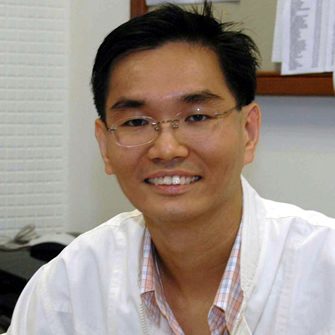
Ernest Chua
Deputy Head (Research) Kian Jon, Ernest Chua
Faculty & Department
Joint Appointments
Deputy Head (research), Mechanical Engineering, College Of Design And Engineering
Education
Doctor of Philosophy, National University of Singapore, Singapore
Bachelor of Engineering (Mech Eng) Hons Class IIB, National University of Singapore, Singapore
Bio
Assoc Prof. Chua specializes in thermal engineering research, focusing on designing, fabricating, and testing sustainable thermal energy systems for heating, cooling, and humidity control in various applications. His work includes advancements in sustainable cooling, moisture control, membrane dehumidification, and efficient thermal energy recovery. He is a Fellow of the Royal Society, the Institution of Engineering and Technology, the Energy Institute, and IMechE. Consistently, recognized as one of the top 1% of scientists globally by the Universal Scientific Education and Research Network and top 2% of energy researchers by Elsevier, he also serves as Associate Editor for several leading journals in Elsevier, Wiley, and Taylor & Francis and sits on the editorial boards of many others. His research has earned him multiple local, regional, and international awards.
Affiliated Scholarships
View Affiliated ScholarshipsContact Information


Welcome!
We’re thrilled you’re considering joining our research team. As a PhD student, you’ll explore cutting-edge advancements in HVAC, air conditioning, evaporative cooling, and thermal energy management. Our focus is on developing sustainable, energy-efficient solutions for climate control and energy use in buildings.
Join us to engage in innovative, interdisciplinary research at the intersection of engineering, sustainability, and technology. We look forward to supporting your growth and collaborating on impactful, future-shaping work.
We can’t wait to see what we’ll achieve together!
I am well-known for my works on unconventional cooling and dehumidification processes, and thermal
energy recovery. My group has performed significant work on identifying composite materials and
synthetic strategies, leveraging exergy-entropy platform, and intensive computational methods to develop
breakthrough membrane dehumidifier, composite superabsorbent desiccant, compressor-less chemicalfree
based air conditioning system that does not dissipate heat, and thermally-cascaded processes. Many
of my fundamental discoveries are being used by others in the scientific communities. My team has made
it a focal point to gain better fundamental insights on the enhanced transport phenomena through new
counter-flow thin-layer evaporation, composite materials, and thermal energy storage and processes. In
particular, we have proposed the concepts of “tri-hybrid material synthesis” and “energies-entropyexergy”
which have provided a new framework to understand how these unconventional thermal devices
operate while designing new approaches to promote their heat and mass transfer performance and
efficiencies. Another key contribution from my team is the elucidation of the fundamental limits to efficient
membrane and composite desiccant dehumidification. Understanding these limits serve as the idea
benchmarks that are theoretically critical to designing and developing future high-performing membrane
and composite desiccant-based moisture removal devices. In addition, minimizing the trade-off between
material selection and synthesis process, improved transport phenomena, and overall effective device
performance can be established. In the real world applications, my team has studied and explored
hybridizing our unconventional dehumidification and cooling technologies to initiates the new starting point
for the next generation of environmentally sustainable and energy-efficient air conditioners for all weather
conditions. A further notable contribution from my group entails the combination of two separate
platforms (1st platform – smart exergy-matching and waste heat cascading utilization and 2nd platform –
a mixed-mode Fuzzy and Pareto optimization) to evolve an intriguing platform that enables smart thermal
component-system design, whilst providing a means for maximizing of components’ system-in-system
performance and eventually overall thermal system performance; yielding optimum amount of thermallydriven
utility productions and achieving maximum system efficiency.
My research interests are centered around improving the efficiency, sustainability, and performance of HVAC systems, with a specific focus on air conditioning, evaporative cooling, and dehumidification technologies. I am particularly interested in exploring innovative methods for optimizing thermal energy management in built environments to reduce energy consumption and carbon footprints.
Key areas of focus include:
- Air Conditioning and HVAC Systems: Examining the latest advancements in air conditioning technologies, including energy-efficient refrigerants, heat pump systems, and the integration of smart controls to improve system performance while minimizing energy use.
- Evaporative Cooling: Investigating alternative, environmentally friendly cooling techniques, such as evaporative cooling, which leverages water evaporation to reduce temperatures, offering a low-energy solution in dry climates.
- Dehumidification: Exploring efficient dehumidification strategies to maintain indoor air quality, comfort, and energy efficiency, especially in areas with high humidity.
- Thermal Energy Management: Investigating novel methods to capture, store, and redistribute thermal energy, focusing on passive and active strategies that balance heating and cooling needs while optimizing energy consumption.
The ultimate goal is to develop integrated, low-impact solutions that can contribute to greener, more energy-efficient buildings and systems.