


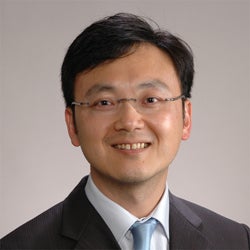
Kun-Lin Yang
Faculty & Department
Joint Appointments
Deputy Head (academic And Student Affairs), Chemical And Biomolecular Engineering, College Of Design And Engineering
Deputy Head (Academic and Student Affairs), Chemical and Biomolecular Engineering, College of Design and Engineering
Education
Doctor of Philosophy, Georgia Institute of Technology, United States
Bachelor of Science in Engineering, National Taiwan Univ, Taiwan
Bio
Dr Yang Kun-Lin is currently an Associate Professor and Deputy Head of the Department of Chemical Engineering and Biomolecular Engineering at the National University of Singapore (NUS). His research areas include liquid crystal elastomers, microfluidic systems, and chemical and biological sensors. As a pioneer in the field of liquid crystal microfluidic sensors, he has leveraged this platform to develop a series of real-time, naked-eye sensors capable of detecting poisonous gases, proteins, nucleic acids, and antibody antigens.
In addition to his contribution in sensor, Dr Yang is also an expert in green technology, wastewater treatment and biofuels. His green catalysts and oxidation processes have been widely used in industrial applications, including oil bleaching, wastewater treatment, sludge digestion, and production of sustainable aviation biofuels. Over the past five years, he has actively translated his research findings into start-up companies, including GreenAct, GreenCOP and GreenDr. Notably, GreenCOP has received several awards, including Shell Startup Engine (2022), 1st runner up in Pier 71 Smart Port Challenge (2022), University Startup World Cup Global Challenge Award (2023), Grand Finalist in the Liveability Challenge by Temasek Foundation (2024).
Dr Yang has more than 160 papers as 10 patents under his name. He has also been invited to serve as a consultant for many companies, assisting them in addressing sustainability and wastewater challenges.
Contact Information

You are welcome to discuss your research interest with me!
Liquid crystals (LCs) have been widely used in electronic displays and sensors. In the past, my group was dedicated to exploit unique optical and orientational properties of LCs to develop a new type of microfluidic LC sensor for a wide range of applications including chemical and biological sensors, medical diagnosis and environmental monitoring. In a recent study [1], we showed that the orientations of LC could be controlled dynamically in a microchannel by using different flow rates and boundary conditions. Subsequently, the LC was polymerized and became a free-standing, highly-sensitive chemical sensor for detection of chemical vapors over a large surface area [2]. This is the first chemical sensor which can translate spatial distribution of different chemical vapors into a color map for naked-eye detection. Moreover, we also explored the properties of LC to develop biosensors [3, 4], immunoassays [5] and enzymatic assays[6] for high-throughput and multiplexed detection of DNA, antigens and enzymes which are critical for human health. In a recent paper [5], we showed that an automated microfluidic immunoassay with a built-in LC detection mechanism could be realized. Detection of immuno-binding events was accomplished through the observation of LC textures inside a microchannel. We also showed that it is possible to couple microchannels with tubing cartridge pre-loaded samples and reagents to realize high-throughput screening.
- Liu, Z.D., D. Luo, and K.L. Yang, Flow-driven disclination lines of nematic liquid crystals inside a rectangular microchannel. Soft Matter, 2019. 15(28): p. 5638-5643.
- Liu, Z.D., D. Luo, and K.L. Yang, Monitoring the two-dimensional concentration profile of toluene vapors by using polymer-stabilized nematic liquid crystals in microchannels. Lab on a Chip, 2020. 20(9): p. 1687-1693.
- Jannat, M. and K.L. Yang, Liquid crystal-enabled protease inhibition assays developed in a millifluidic device. Sensors and Actuators B-Chemical, 2019. 296.
- Ong, L.H. and K.L. Yang, Surfactant-Driven Assembly of Poly(ethylenimine)-Coated Microparticles at the Liquid Crystal/Water Interface. Journal of Physical Chemistry B, 2016. 120(4): p. 825-833.
- Zhu, Q. and K.-L. Yang, Microfluidic immunoassay with plug-in liquid crystal for optical detection of antibody. Analytica Chimica Acta, 2015. 853: p. 696-701.
- Jannat, M. and K.L. Yang, Continuous protease assays using liquid crystal as a reporter. Sensors and Actuators B-Chemical, 2018. 269: p. 8-14.
- Synthesis of metal-based green catalysts for novel catalytic oxidation processes in wastewater treatment and fabric bleaching. We are also interested in using the technology for pretreatment of biomass and sludge digestion.
- Development of next-generation chemical and biological sensors for medical diagnosis and environmental monitoring. These sensors have been successfully used for detection of DNA, antibiotics, volatile organic compounds, metal ions and micropollutants in wastewater.
- Engineering of microfluidic/millifluidic reactors for continuous manufacturing of immobilized enzymes, electrosynthesis of pharmaceutical compounds and fermentation
Green Catalytic Oxidation for Industrial Wastewater Treatment and Manufacturing Processes
We synthesized oligopeptide-metal complexes based catalysts and developed a green process for partial oxidation of organic compounds with high specificity. When the catalyst combines with hydrogen peroxide or ozone, it becomes a powerful yet selective oxidant which oxidizes phenyl groups and unsaturated double bonds. The process is highly robust and can be performed in different media under ambient conditions. It also has many industrial applications such as green manufacturing and wastewater treatments. The process only requires a minimal amount of oxidant and is cost-effective compared to traditional advanced oxidation processes (AOPs). Under this project, we firstly developed a food-safe oxidization process to bleach vegetable oil and lecithin. The technology was patented and licensed to a company GIIAVA in 2019. Meanwhile, through industrial collaboration with JTC, we conducted both pilot-scale and full-scale studies on a wastewater treatment plant in Jurong Rock Cavern (JRC). We demonstrated that both phenol and hydrogen sulfide in the wastewater can be removed by using the oligopeptide-metal complexes and the treated wastewater can be discharged to the sea directly without further treatment. No secondary waste is produced and the process is energy efficient. Based on the new technology, we spin-off a company Green-COP to commercialize this process for industrial wastewater treatment with support from NUS GRIP programme. Meanwhile, we performed pilot-scale studies for several potential customers including Matex, NSL-Oilchem and Wilmar. We are exploring new applications for customers including Clariant (Germany) and Towngas (Hong Kong) for wax bleaching and pretreatment biomass.
My Mentoring Style
How would you describe your mentoring style in terms of freedom given to your students?


Selecting Research Topics?
How do you guide your PhD students in selecting research topics?
Setbacks / Challenges
How do you handle setbacks or challenges faced by your PhD students?
Consultation Frequency
How often do you typically meet your PhD students one-on-one for consultation?