Xue Wen Tan is an AI Scientist at IMDA with a PhD in Digital Financial Technology from NUS at the Asian Institute of Digital Finance, specialising in AI for finance. He has worked across industry, academia, and the public sector. His work focuses on translating cutting-edge AI research into realworld solutions and developing safe & scalable agentic AI systems.
Brief Introduction to PhD Research:
Tan Xue Wen’s PhD thesis is titled “Human-Centered AI for Informed Financial Decision-Making.” His research explores how people can effectively adopt and interact with AI in highstakes financial contexts, advocating a shift away from black-box automation towards systems that support and enhance human judgment. To achieve this, AI systems should be transparent, trustworthy, and capable of providing actionable insights to human decision-makers.
What sparked your interest in this field?
Before starting my PhD, I worked as a technology associate at a bank in Singapore, where I gained first-hand exposure to FinTech. The COVID-19 pandemic became a major turning point. With in person interactions severely restricted, digital banking was no longer simply an option. It became essential for maintaining everyday banking operations. This accelerated the industry’s digital transformation and demonstrated how technology could improve both operational efficiency and customer access. At the same time, AI was beginning to gain traction, although not at the pace we are seeing today. I became particularly interested in a fundamental question: How can we encourage the responsible adoption of AI in a highly regulated and high-stakes field such as finance? I realised that strong performance alone would not be enough. For people and institutions to adopt AI confidently, these systems must also be transparent, trustworthy, and useful in supporting human judgment. That experience ultimately inspired my PhD research on human-centered AI for informed financial decision-making.
Any key breakthroughs or proud milestones in your work so far?
There was no single breakthrough or milestone that stood out to me. Throughout a PhD, every stage matters, and I believe consistency is key. Each experiment, revision, and discussion contributes to the final outcome.
If I had to identify one particularly meaningful milestone, it would be completing my thesis. Writing it was challenging because I had to evaluate my own work critically, ensure that my experiments were rigorous and comprehensive, and verify that my findings were supported by the evidence and interpreted accurately. As I reviewed my research in detail, I identified several weaknesses and areas for improvement. Although this was difficult, it ultimately allowed me to refine my research, strengthen my analysis, and produce a much stronger thesis.
For me, completing the thesis was not just about finishing my PhD. It was also an important lesson in critical self-reflection, persistence, and the importance of continually refining one’s work.
Graduate School didn't just teach us techniques. It trained our reflexes towards uncertainty. To pivot without losing purpose. To recalibrate without losing confidence.
If you could fast forward 10 years, what impact would you hope your research has made?
I would not want to overstate the potential impact of my research. Like many research contributions, its value may not be immediately visible, and there is nothing wrong with that. Research is fundamentally about pursuing knowledge, challenging existing assumptions, and gradually expanding the boundaries of what we understand.
Ten years can be a relatively short period in research, as some ideas may only be proven useful much later. I hope my work will serve as the bedrock for future research on human-centered AI in finance. If it helps others develop AI systems that are more transparent, trustworthy, and effective in supporting human decision-making, I would consider that a meaningful impact.
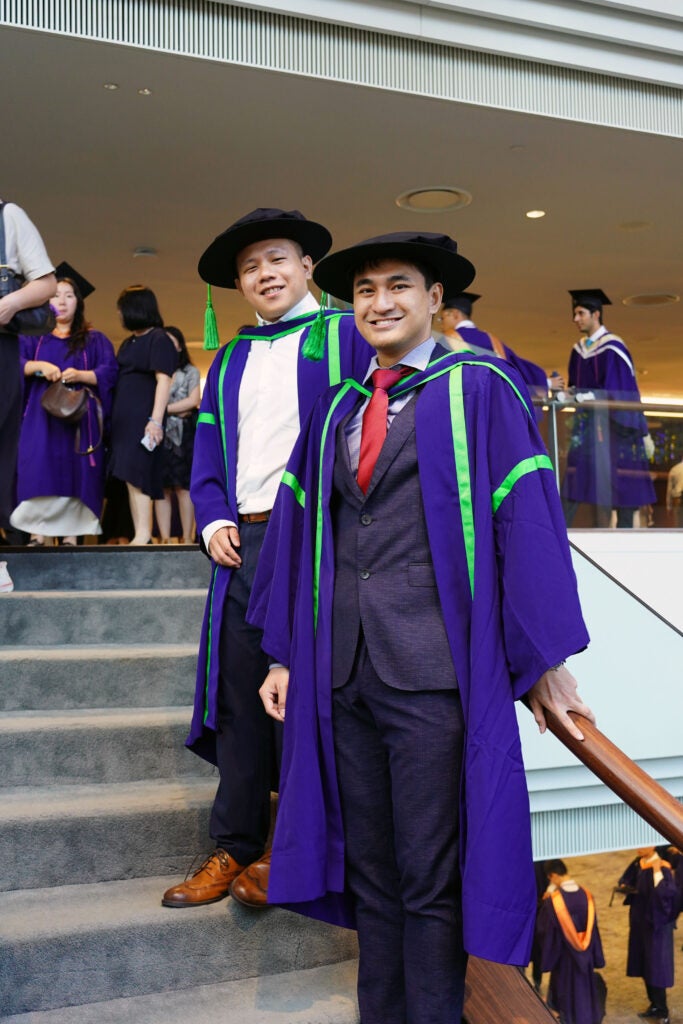
Dr. Tan Xue Wen before the 2026 Commencement Ceremony
Our superpower isn't that we know everything. It's that we can face the unknown without fear.
What’s one piece of advice you’d give to someone considering a PhD in your programme or in general?
My advice would be to think carefully about the kind of mentorship and research environment that suits you, while remaining open to exploring ideas beyond your main research direction.
I sometimes compare PhD supervision, somewhat playfully, to the mentorship structures in Star Wars. A large research lab can resemble the Jedi Order, where you learn from a broader community of researchers and benefit from the collective knowledge of the group. A smaller lab can resemble the Sith’s Rule of Two, where you work closely with one supervisor who passes on their specialised knowledge and experience. Both models have their strengths. What matters most is having a healthy working relationship with your supervisor and choosing an environment that matches the way you learn and work.
At the same time, do not put all your eggs (time), in one (research) basket. Some of the papers I published began as side projects or ideas developed through module term projects. These projects often turned out to be among my most original work because they gave me the freedom to explore questions that I genuinely cared about. A PhD requires focus, but staying curious and exploring different directions can lead to some of your most meaningful research.
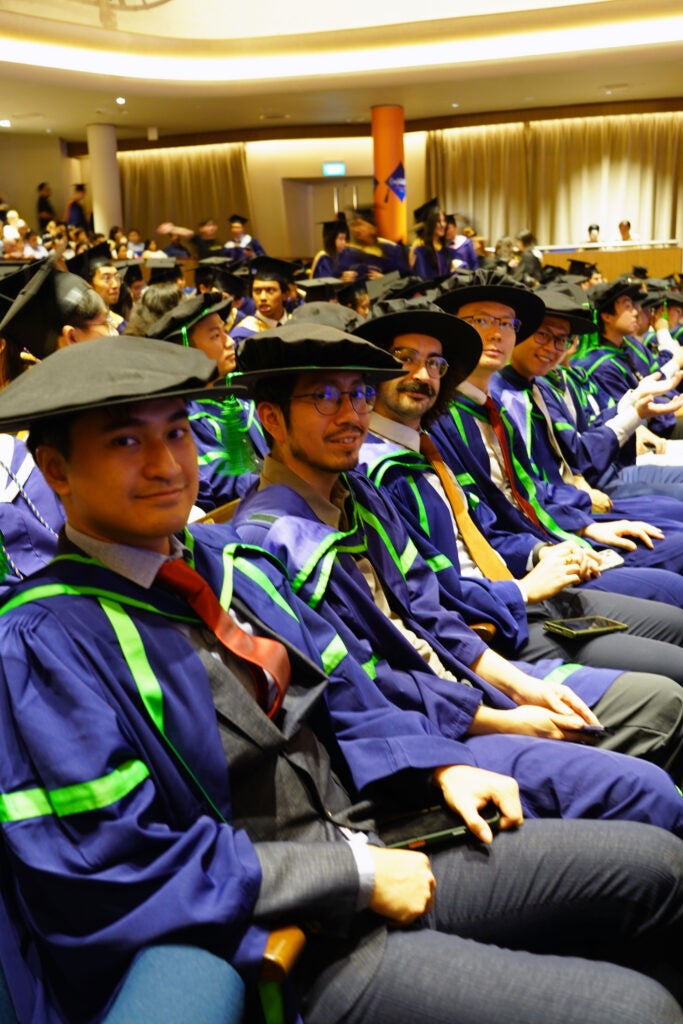
Dr. Tan Xue Wen with his fellow PhD graduates at the 2026 Commencement Ceremony
The world you are stepping into will feel overwhelming at times, but don't let the noise dictate your path. Keep working on what makes you curious. If you do that, success will be yours to savor when the time is right.
Having graduated, what do you think your next steps would be?
I am currently working as an AI Scientist at IMDA, where I focus on building safe and scalable agentic AI systems and contributing to the growth of Singapore’s AI ecosystem. Looking ahead, I hope to continue bridging the gap between research and real-world application by translating advances in AI into practical systems that create meaningful value for organisations and society.
Graduating does not mean that my research journey has ended. I still read research papers in my free time, both out of personal interest and to support my work. I also intend to continue conducting research, collaborating with other researchers, and publishing whenever possible. Staying engaged with research allows me to continue learning and remain informed about the latest developments in AI.
The PhD programme has also changed the way I approach problems and view the world. It taught me to think critically, work with uncertainty, and challenge the status quo. I believe this mindset will be especially valuable during this period of rapid technological change. As AI reshapes many tasks that we once considered valuable or uniquely human, it is increasingly important to identify areas in which human judgment, creativity, and accountability remain essential. I hope to carry this mindset with me throughout my career and for the rest of my life.