My name is Joel, and I was awarded the A*STAR Graduate Scholarship in 2021 to study my PhD under the NUS Integrative Sciences and Engineering Programme. I was jointly supervised by Associate Professor Duane Loh from NUS Physics as well as Dr. Arseniy Kuznetsov and Dr. Ramon Paniagua from A*STAR IMRE. My PhD research focused on developing computational algorithms to solve inverse problems in two particular systems — cryogenic electron microscopy (cryo-EM) and metalens imaging. In short, the raw measurements in these imaging systems are often contaminated with unwanted aberrations and noise. The goal is then to reconstruct the object of interest from these corrupted images based on the physics of how images are formed in these systems.
What sparked your interest in this field?
Back in 2018, I was studying the physics of black holes during my undergraduate final year project. However, I personally found it difficult to appreciate this field of research as I could not physically touch or see the black holes I was studying (note this was before the first image of a black hole in 2019). After obtaining my bachelor’s degree, I was offered a position in A*STAR SIMTech as a research engineer which exposed me to laser physics and imaging. It was during this first job that I also first learnt how to perform numerical simulations and traditional image processing. One of the projects at that time required me to reconstruct a 2D object from its 2D Fresnel diffraction pattern (also known as coherent diffractive imaging), and that was what got me interested in computational methods for inverse problems in imaging.
Any key breakthroughs or proud milestones in your work so far?
Cryo-EM is a relatively mature field, with many existing software capable of reconstructing a 3D biological structure from many noisy 2D images developed over the years. At the start of my PhD, I only had experience working with 2D data. I still recall being very hesitant towards my PhD supervisor to move towards 3D reconstruction because I thought that it would take too long for me to develop the ability to do so.
At that time, I just started learning about deep neural networks, which were comprised of multiple layers of neurons which were trained using the simple idea of gradient backpropagation. I then had the sudden realization that a 3D object could also be similarly viewed as just a collection of 2D planes stacked back to back, where light (or in my case, an electron beam) would propagate through each plane sequentially before exiting from the sample. This meant that I could borrow the idea of gradient backpropagation from training neural networks, to also apply it to updating the voxels of a 3D volume. Of course, it took a while to actually get this idea implemented in code, but it most definitely felt like a ‘eureka’ moment when I started to see my first 3D reconstruction of a biological protein from real experimental images!
Slowly, we came to understand that these setbacks were not a detour from the PhD. They were the PhD.
If you could fast forward 10 years, what impact would you hope your research has made?
At its core, the computational methods developed in my research during my PhD is based on the premise that there is meaningful signal (or information) in our measured 2D images which we can exploit to improve our reconstruction of the sample we are trying to image. Rather than investing more time or money to upgrade the hardware to achieve higher resolution (which, no doubt, is one way forward), we can leverage computational methods instead to obtain high resolution reconstructions as well. Thus, the hope is to make cryo-EM imaging more accessible to other labs by replacing certain expensive components of high-end electron microscopes by computational methods (for example, physical aberration correctors or utilizing lower energy electrons).
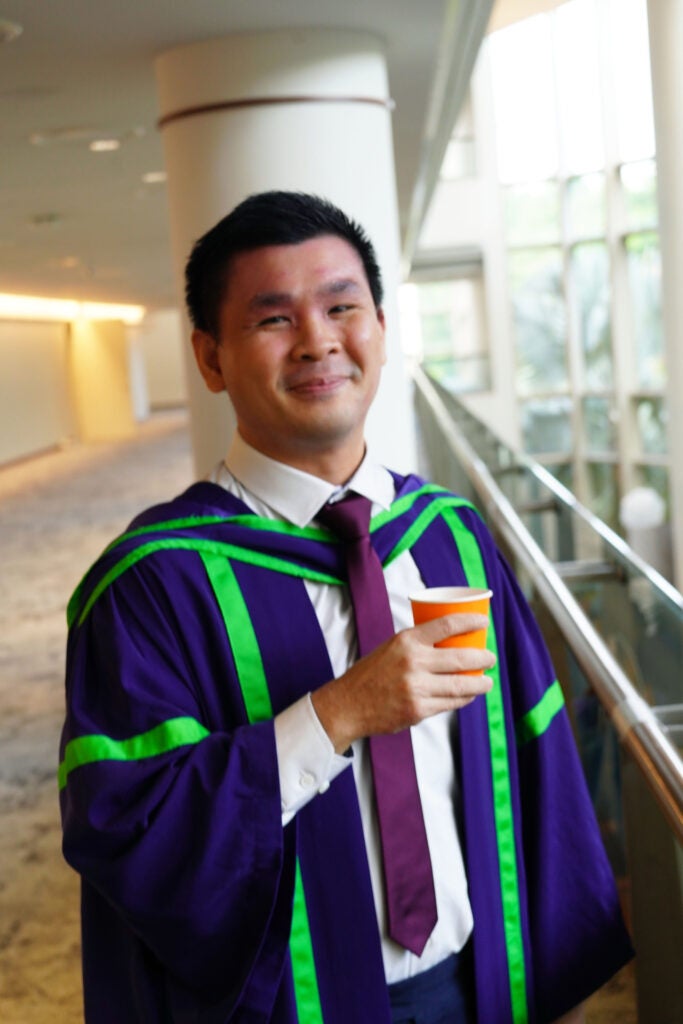
Dr. Yeo Zhi Wei Joel before the 2026 commencement ceremony.
The fear was not that AI would take our jobs. It was that our fields were now moving faster that what we could follow. So, we had to learn to move with it.
What’s one piece of advice you’d give to someone considering a PhD in your programme or in general?
Your chosen PhD research topic does not lock you into a specific career path! I’ve met many friends who have progressed to entirely different fields of research from what they studied during their PhD. The landscape of science is continuously changing, and what a PhD experience gives you is learning how to embrace change (and failures). Apart from technical knowledge, a PhD study also teaches you many soft skills like problem solving, communication, and even teaching — all of which are valuable regardless of your future job.
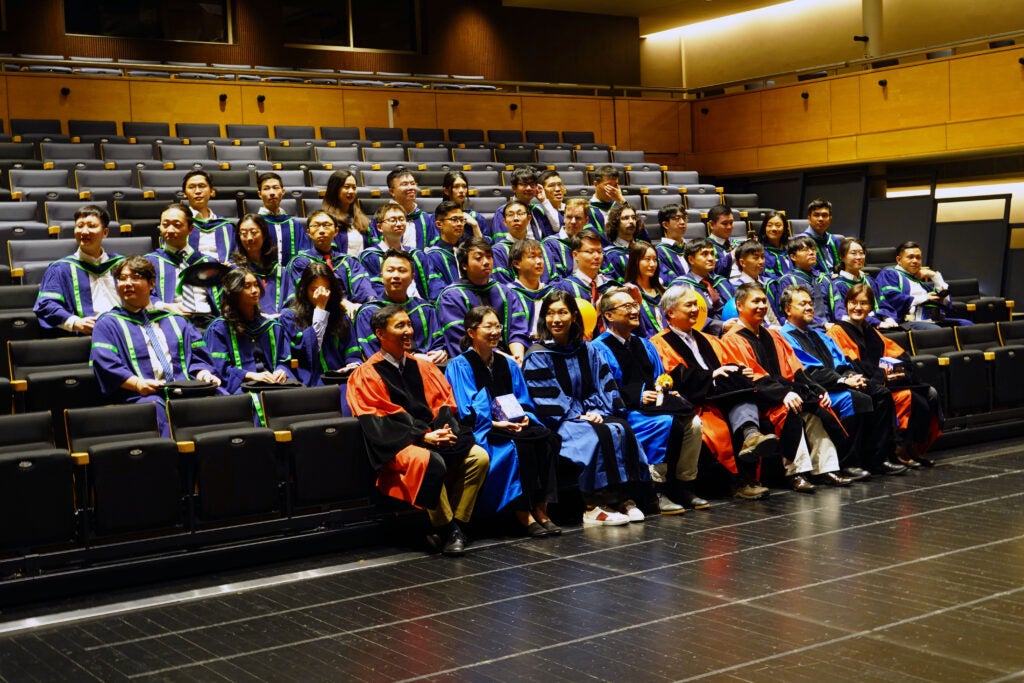
Dr. Yeo Zhi Wei Joel (3rd Row, 3rd from the right) with the PhD graduating class of 2026.
We did not compete with AI. We learnt to direct it. And so, we adapted once again. Three times disruptions arrived. Three times we found our footing. That capacity to adapt is perhaps the most valuable thing our PhD has given us.
Having graduated, what do you think your next steps would be?
I am currently working as postdoctoral research fellow in NUS Center for Bioimaging Sciences, funded under the Chan-Zuckerberg Imaging Institute (Biohub). As the field evolves into utilizing machine learning methods, there is a lack of ground truth data to train supervised learning models in cryo-EM. Thus, right now I am focused on building a realistic simulator for cryo-EM imaging so that deep learning models can train on simulated data and hopefully work on real-world experimental data for downstream processing tasks.